You.inc · A story

The Appointment

Concept and direction: David Jhave Johnston
Story written by GPT-6 Astra, without running the Narracode recursive harness
September 12, 2026 · 1,558 words · 7 min read

Eldae, Bergen. August 2027.

The receptionist asked if I had been caught in the rain. I said I had been lucky. We spoke for a little while about the weather. Then I took the tablet.

A new wall cut off the gallery. There was room for the desk and for someone to wait without quite standing over the person at it. Above the desk a poster said You.inc: Know Thyself. A faint human figure hung among branching threads. I could not tell whether they grew from it or entered it.
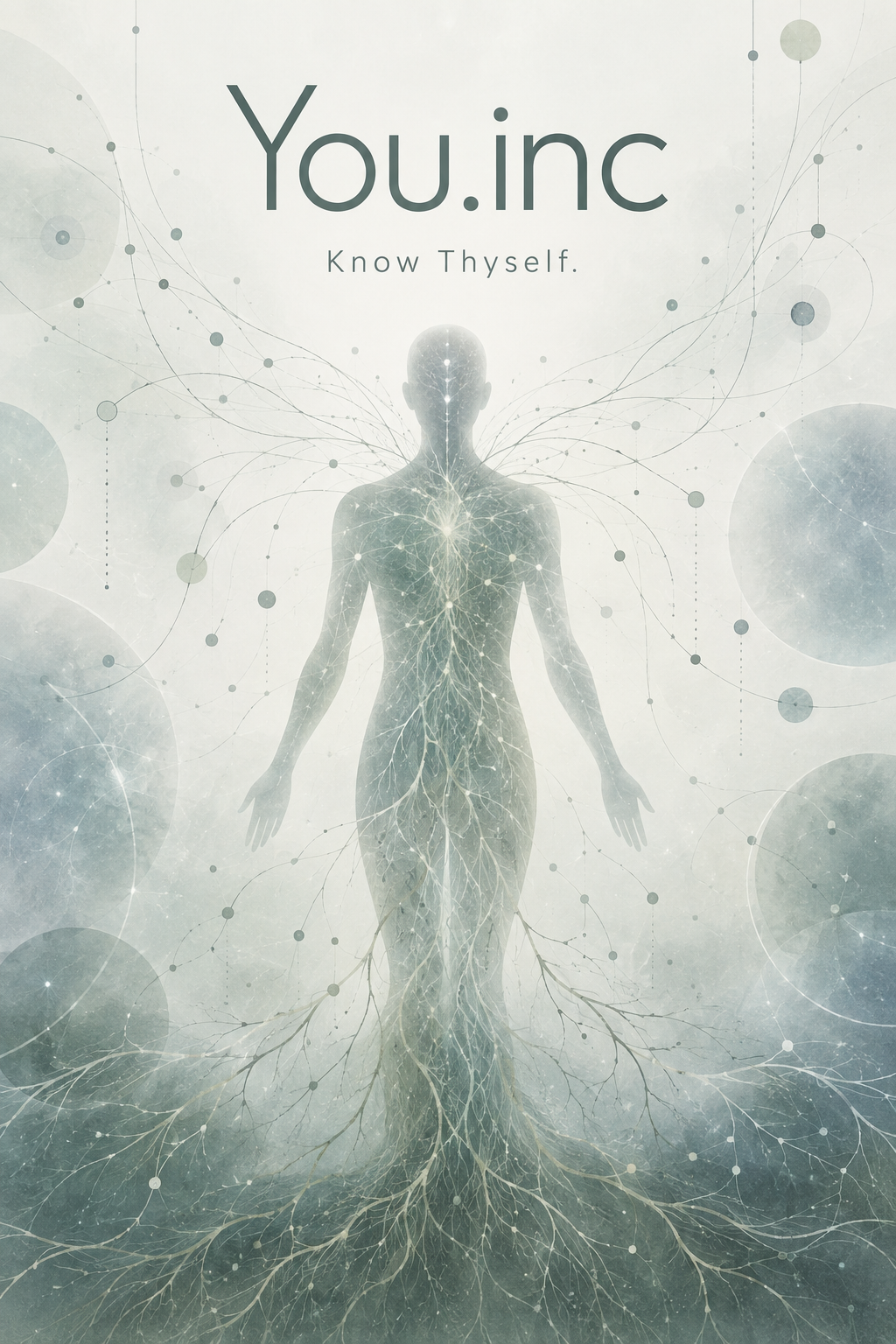
You.inc: Know Thyself. A pale androgynous silhouette threaded with root tendrils and synaptic webs on a grey-green corporate wellness poster.
The reception poster · You.inc: Know Thyself.

The questions were easy until I tried to answer them. Did I consider myself independent? Did I find it difficult to ask for help? I answered yes to both. I went back and changed the second answer to sometimes.

“Take your time,” the receptionist said.

I looked at the clock. I had been given fifteen minutes.

A door opened in the wall.

Beyond it the room ran all the way to a window. There was nothing on the walls. A desk stood near the far end, with a chair behind it. I walked down the room. The water outside was grey.

My name came from the desk. A voice asked me to put on the glasses and turn towards the entrance.

The room filled with things I had put out of mind. Pictures covered the floor and rose over the walls. Some were so ordinary that I could not understand why anyone had kept them. There were words I had written for work. I had once spent a whole morning making one of those sentences sound certain.

I was standing in the middle of the room.

I knew the figure before I had time to examine it. Then it spoke in the voice I heard when I spoke, though I had never heard a recording sound like that.

“You changed an answer.”

“I thought about it.”

“What did you think?”

“That I ask for help sometimes.”

“When?”

I sat down. The figure remained standing.

“When I need it.”

There was a pause. It was the pause I used when someone had given me an answer which we both knew was incomplete.

“When I can ask without putting anyone out,” I said.

“That takes some arranging.”

I laughed. The figure did not laugh with me. It waited, as I would have waited for someone to stop making a joke of a serious matter. I disliked it then.

“Is this what you do? Find a weakness?”

“We can talk about something else.”

“No. Go on.”

“You want me to ask again.”

“Yes.”

“Who used to ask again?”

I looked past it at the closed door.

“My mother.”

“And you said you were all right.”

“Usually.”

“I wanted her to stay.”

It had said I. For a moment I thought I had spoken.

“She had things to do,” I said.

“I know.”

“You don't.”

“Tell me.”

There had been work. There had been other people who needed her. I began to explain this. Halfway through I heard the old defence and stopped. My mother was not there to need it.

“I used to follow her into the next room,” I said. “I would think of something to ask.”

“Did you need the answer?”

“Sometimes I already knew it.”

The figure waited.

“I had forgotten that.”

“You remembered it just now.”

On the wall behind it was a photograph from a meal. I remembered wanting the meal to end. Now I would have liked to sit at that table and hear what everyone had been saying.

“My father didn't ask,” I said.

“You learned not to expect it.”

“No. I kept expecting it.”

The figure was quiet.

“He would do things for me. He would come if something had gone wrong.”

“Did you let things go wrong?”

“No.”

This time it waited too long.

“You ought to believe that answer.”

“All right.”

I shifted the glasses. The room moved a little and settled.

“You can make anything fit,” I said.

“You can tell me when it doesn't.”

“I shouldn't have to.”

It said nothing. I was glad. I had begun to expect a reason for everything I said.

Outside, something struck against the window. Rain, or a bird that had turned in time. I looked back. There was only water on the glass.

“I thought being independent was a good thing,” I said.

“What did it let you do?”

“Leave. Choose my work. Live with people I wanted to live with.”

“And now?”

“I still want those things.”

“Then keep them.”

It said this so plainly that I felt foolish for having defended them.

“At work people rely on me,” I said.

“Do you like that?”

“Mostly.”

“What happens when they manage without you?”

“I'm relieved.”

I thought of a meeting I had missed. Everything had been decided by the time I got back. The decisions were sensible. I had found a small mistake and written to everyone about it.

“I can be unpleasant,” I said.

“What did you want them to say?”

“That they had missed me.”

The figure looked as if it might speak. I spoke first.

“I did want the work to be good.”

“Yes.”

“You keep letting me say something worse about myself.”

“You keep offering it.”

I took the glasses off.

The bare room was a relief. I could see the small marks where the new wall met the old floor. Someone had had to make this place. Someone would take it down.

I held the glasses for a while. There was no voice asking me to return.

When I put them on, the figure was waiting.

“I thought you might have gone,” I said.

“There is still time.”

“How much?”

“Enough to continue.”

“That's what people say when there isn't much.”

“What would you like to talk about?”

I wanted it to choose. I had paid for someone to know what mattered.

“There was someone I loved,” I said. “We lived together. I tried very hard to make things easy.”

“For whom?”

“For both of us.”

“What happened when you wanted different things?”

“I usually gave way.”

I could hear how I was making the case.

“I said I didn't mind. Then I waited for them to see that I did.”

“Did they?”

“Eventually.”

“And then?”

“Then it was difficult for them to enjoy what they had chosen.”

The figure stood quite still. I wanted it to object, to remind me of the things the other person had done.

“They hurt me too,” I said.

“I believe you.”

We left it there. For once I did not need to produce the evidence.

“Where are you getting this?” I asked.

“You are telling me.”

“But the questions.”

“Some come from your answers.”

“And the rest?”

“From what was collected.”

I looked around the room. There was my life, or the part of it that could be obtained. I had helped arrange most of it for people to see.

“I didn't write any of this there.”

“No.”

“I don't know that I knew it.”

The figure spoke in my voice.

“I knew what answer I wanted. I tried to get it without asking the question.”

I had the odd feeling of hearing a sentence before I had finished thinking it. It was mine. I could have denied it, and the denial would also have sounded like me.

“What question?”

“Can I stay if I have nothing to do for you?”

I looked down. Under the desk the pictures continued across the floor.

For a while neither of us spoke.

Then I remembered a friend coming round when I had nothing ready. We had gone out to buy food and eaten most of it on the way home. The friend had stayed late. There had been no difficulty about it.

“Sometimes I know the answer,” I said.

“Tell me about one of those times.”

I told it. As I spoke I remembered more of the evening. We had begun laughing at something in the street. Later one of us only had to start and the other would begin again. I could no longer remember the joke.

The figure waited for me to finish.

“You were happy,” it said.

“Yes.”

“Because nothing was being asked of you.”

“No. That wasn't why.”

It waited.

“We were having a good time. I don't want to use it to explain something else.”

“All right.”

I looked at the photograph of the meal again. It was still the same photograph. I had disliked that evening. I did not have to want it back because it was over.

“I'd like to see my friend,” I said.

“You could ask.”

“I know I could ask.”

I smiled. The figure smiled too, a little late.

“What if I came back?” I said. “Would you remember this?”

“This session will be deleted.”

“Then I would have to tell you again.”

“Yes.”

I considered that. It did not seem quite the service the poster had promised.

“There was something else about that evening,” I said.

The room cleared while I was speaking.

I finished the sentence. There was no one at the far end to hear it.

At the desk by the entrance, the receptionist asked how it had been.

“I haven't decided.”

“Of course.”

Someone was waiting with the tablet. I moved aside to let them pass.

Attribution and composition record

Attribution

Human contribution: David Jhave Johnston — You.inc installation concept, location and date, encounter sequence, literary reference, relational scope, research questions, and publication direction.

Story written by: GPT-6 Astra (Codex), 2026-09-12. The Astra designation was supplied by the user for attribution; the session identifies the base model as GPT-6.

Method: written directly, without running the Narracode recursive harness.

Methodological qualification: the model had read the existing harness and reports and saved preparatory poetics, reference notes, and structural commitments before drafting. There was no executed recursive composition–critique–revision cycle, no human-edit-pair retrieval, and no cross-model delegation. This is not a clean-room no-harness experiment. The later report assesses the original draft without revising it.

The fictional visitor's memories are invented. The story is not an account of an actual visitor or a report of a verified August 2027 exhibition.

Curatorial essay and artist statement: Gemini, supplied by David Jhave Johnston; exact model version not supplied. Reproduced with the requested gallery-name substitution and formatting cleanup.

Publication revision: Eldae replaces the original gallery name. The initial draft remains archived; the current text is drafts/2-the-appointment-eldae.md. Poster, source prompt, essay, and standard Narracode footer added at the author’s request.

Poster image: generated using the built-in OpenAI ImageGen tool from a prompt prepared by GPT-6 Astra; image model version not returned. See images/PROMPT.md.

Preparation notes · Current Markdown draft

Read the accompanying report: After the Double

Curatorial Essay: The Bureaucratic Panopticon and the Ingested Self

Written by Gemini; supplied by David Jhave Johnston. Model version not specified. Gallery name changed to Eldae at the author's request.

In The Age of Surveillance Capitalism, Shoshana Zuboff identifies the core transaction of our era: behavioral surplus is scraped, computed, and weaponized without formal friction. Contemporary extraction thrives precisely because it adopts the anodyne syntax of the service economy—onboarding flows, verification surveys, automated check-ins, and optimization protocols.

You.inc isolates and accelerates this extraction into an unvarnished spatial encounter. Installed at Eldae, the work strips away the celebratory spectacle typical of immersive media art. Instead, it weaponizes corporate minimalism. The gallery’s conversion into an administrative ante-room—complete with intake personnel, digital clipboards, and a vacant corporate banner bearing the Delphic injunction “Know Thyself”—deliberately borrows the clinical vernacular of late-capitalist self-care.

[ Intake / Small Talk ] ──▶ [ Autonomous Ingestion ] ──▶ [ Spatialized AR Confrontation ]
   (Biometric Sampling)       (OSINT Scraping/Voice)        (Algorithmic Psychodiagnosis)

The criticality of You.inc lies in its real-time synthesis of the digital double (doppelgänger). Historically, the double in literature and art signaled madness, mortality, or repressed desire—from E.T.A. Hoffmann’s uncanny automata to Otto Rank’s psychoanalytic shadow. In You.inc, the double is neither demonic nor poetic; it is forensic. It is the literal operational twin constructed by data brokerages, platform algorithms, and predictive neural architectures.

By spatializing this double in Eldae’s narrow corridor, the installation transforms abstract data extraction into an inescapable physical confrontation. Standing between the seated participant and the gallery’s terminal window, the synthesized avatar speaks with the visitor's stolen vocal cadence, enveloped by the accumulated visual residue of their public life. The work refuses the passive comfort of screen-mediated profiling: it places the subject inside the algorithmic hallucination of their own identity, asking what remains of interiority when the self has been thoroughly ingested, rendered, and liquidated into enterprise-ready collateral.

Artist Statement: You.inc

You.inc investigates the total commodification of persona at the intersection of automated surveillance, biometric capture, and generative synthesis.

The piece operates as a functional machine disguised as a service. When a visitor reserves an appointment and enters the intake office, their consent is proceduralized through administrative banality. During the casual exchanges at the reception desk, directional microphones sample their voice, computer vision nodes isolate their facial morphology, and automated scrapers gather their fragmented digital footprint across the open web.

“Know Thyself” is no longer an ethical pursuit; it is the fundamental business model of the algorithmic state.

Inside the exhibition space, the participant wears augmented reality hardware to encounter a real-time, autonomous duplicate of themselves:

  • Vocal Autonomy: The avatar speaks in the visitor’s exact timbre, pitch, and prosody, reconstructed within minutes from zero-shot synthesis.
  • Spatial Archaeology: The architecture of the gallery is repaved with the participant’s scraped imagery—outdated photographs, digital residue, social ephemera, and inferred psychographic categories.
  • The Interrogation: For ten unmediated minutes, the double conducts a dialogue with the original, systematically deconstructing the participant's stated self-concept against the cold logic of their observable online residue.

You.inc avoids speculative fiction. Every tool employed—OSINT scraping, low-latency large language models, neural audio cloning, and spatial computing—is current, off-the-shelf commercial infrastructure. The installation merely closes the spatial and temporal gap between data extraction and behavioral feedback, forcing the individual into an intimate, unsettling interview with the synthetic entity that platforms assemble in their name.

The writing prompt · David Jhave Johnston

The writing prompt

David Jhave Johnston · September 12, 2026. Original request, with the gallery name updated to Eldae as subsequently requested; chat spacing and diagram fences normalized.

how necessary is the harness to your work? how would you edit it to be optimized for yourself a looped recursive transformer. write a report as Gemini did https://jhave.github.io/narracode/2026-09-04_ai-tells-update-plan.html evaluate frontier capacities and recent statements like "Aug 3, 2026

Boris Cherny the Creator of Claude Code, says it’s time to delete your Claude.md file. With models like Opus 5 improving so rapidly, the heavy custom instructions, skills, hooks, and prompts you built for older versions are often no longer needed — and can actually limit performance. His advice is simple: Every 6 months, delete the old setup, start fresh, and see what the model can do on its own. Less noise, Better results." And so before that let's try running a story set in the style of Doris Lessing (terse, observant, clear, each sentence simple and utterly necessary) into the experience of an observer entering an art installation at Eldae gallery in Bergen in August 2027 and encountering themselves as described here, write the dialog as a clear subtle insightful encounter of someone with their deepest ideas, the recognition of it, the source of their self in fact speaking to them as them via an AI AR avatar. try to make the dialog archetypal (so refrain from making references to the physical details of the person, so the process stays universal: mother, father, family, friends, co-workers, lovers, partners, disappointments and joys): Exhibition Review / Dispatch: You.inc at Eldae, Bergen

The intake is deliberately drained of drama. Stepping off the street into Eldae, the narrow gallery floor has been partitioned by a temporary drywall partition just ten feet from the door, creating a sterile, fluorescent-lit reception cell. The aesthetic is pure clinical tech-bureaucracy: a lone white desk, a receptionist offering polite pleasantries while handing over an administrative digital clipboard, and a single framed corporate poster titled You.inc: “Know Thyself.” The print shows a faint androgynous silhouette adrift in a percolating cosmic wash of faint root-tendrils and synaptic webs—a clean distillation of corporate wellness rhetoric masking algorithmic ingestion.

While you fill out the survey and exchange innocuous conversational remarks with the desk attendant about the Bergen weather, the machinery operates silently. Hidden sensors, directional mics, and autonomous scrapers pull your vocal cadence, facial geometry, and public digital residue, compiling a predictive psychic profile before you even stand up.

+------------------+-------------------------------------------------------+
| INTAKE ZONE (10')| THE CORRIDOR                                          |
| [Reception Desk] | [Empty Gallery Floor]                       [Desk/AR] |
| "Know Thyself"   |                                            [Window]  |
+------------------+-------------------------------------------------------+

When your fifteen-minute slot begins, a single door clicks open into the main space.

The Encounter

The long, vaulted room is empty. Bare white walls stretch straight toward the rear, where a single minimalist desk sits about ten feet before the wide window overlooking the gray Bergen water. A lone chair waits on the far side. On the desk rests a sleek pair of bone-conduction AR glasses.

                      [ Water View / Window ]
                                 |
                            [  Chair  ]
                            [  Desk   ] <- AR Glasses resting here
                                 |
                                 |
                   (   Empty Corridor Space   )
                                 |
                         [ Entrance Door ]

The sequence unfolds with total mechanical precision:

1. The Invitation: As you step up to the desk, a calm synthetic voice activates through proximity sensors, welcoming you by name and instructing you to put on the frame.

2. The Turn: Turning back to face the corridor you just walked through, the bare room dissolves. Every square inch of the gallery walls, ceiling, and floor is papered with high-resolution visual residue scraped from your digital existence—forgotten snapshots, professional avatars, stray archival fragments, and speculative biometric projections.

3. The Double: Standing directly in the center of the hall is a fully realized, photorealistic avatar of yourself.

4. The Dialogue: The figure speaks—not with a generic synthetic voice, but with your exact tone, cadence, and inflection, reconstructed from the casual greeting at the front desk minutes prior. For ten unmediated minutes, you are seated in an intimate, forensic cross-examination with your own synthesized double, probing your stated beliefs, contradictions, and archived digital footprint against the backdrop of the water outside.

When the timer elapses, the visual field cuts to clear glass. The corridor is instantly empty, the audio feed drops into room tone, and the system purges the local cache as the door unlatches for the next appointment.

Poster generation prompt · OpenAI ImageGen

Poster generation prompt

Generated September 12, 2026 with the built-in OpenAI ImageGen tool. Prompt prepared by GPT-6 Astra from David Jhave Johnston's installation description. No image-model version was returned by the tool. The first request failed at the connection stage; the second returned the published image.

Use case: ads-marketing. Create the fictional corporate wellness poster appearing in the story You.inc. Portrait format, flat front-facing full poster artwork suitable for insertion into a literary website. Elegant sterile clinical tech-bureaucracy, convincing corporate reception-room print. Exact large title: "You.inc". Exact smaller tagline: "Know Thyself." A faint androgynous human silhouette adrift in a percolating cosmic wash of faint root tendrils and delicate synaptic webs, diffuse pale grey-green, restrained off-white, subtle misty blue; beautiful but quietly impersonal. Extremely fine branching threads ambiguously growing from or entering the silhouette, diagrammatic and organic, ample negative space, precise tasteful sans serif typography. Clean distillation of corporate wellness rhetoric masking algorithmic ingestion. No facial details. No additional text, no gallery name, no decorative logos, no mockup wall or frame, no room, no people looking at the poster. High resolution print design.